
To Trust a Cat
And What We Sacrifice When We Do

Last night (at the time of writing this), I decided to charge my FitBit while I slept. Did it need to be on the charger all night? No, probably not. It only takes an hour or so to get back up to full battery. But I made the decision anyway, knowing that I would be sacrificing a coveted practice of checking the time in the middle of the night, always counting down how many hours I had left in bed before the dreaded morning came.
So I slept. And I woke, and I fell back asleep again without knowing the time. I had dreams inside of dreams, and finally I woke up more consciously. I lay there in bed, my fuzzy eyes adjusting to the darkness. What time was it? Was my alarm hours away from going off, or seconds? I could feel the pull to rise and check the time on my phone—or even better, to grab my FitBit so those commanding numbers would always be encircled around my wrist.
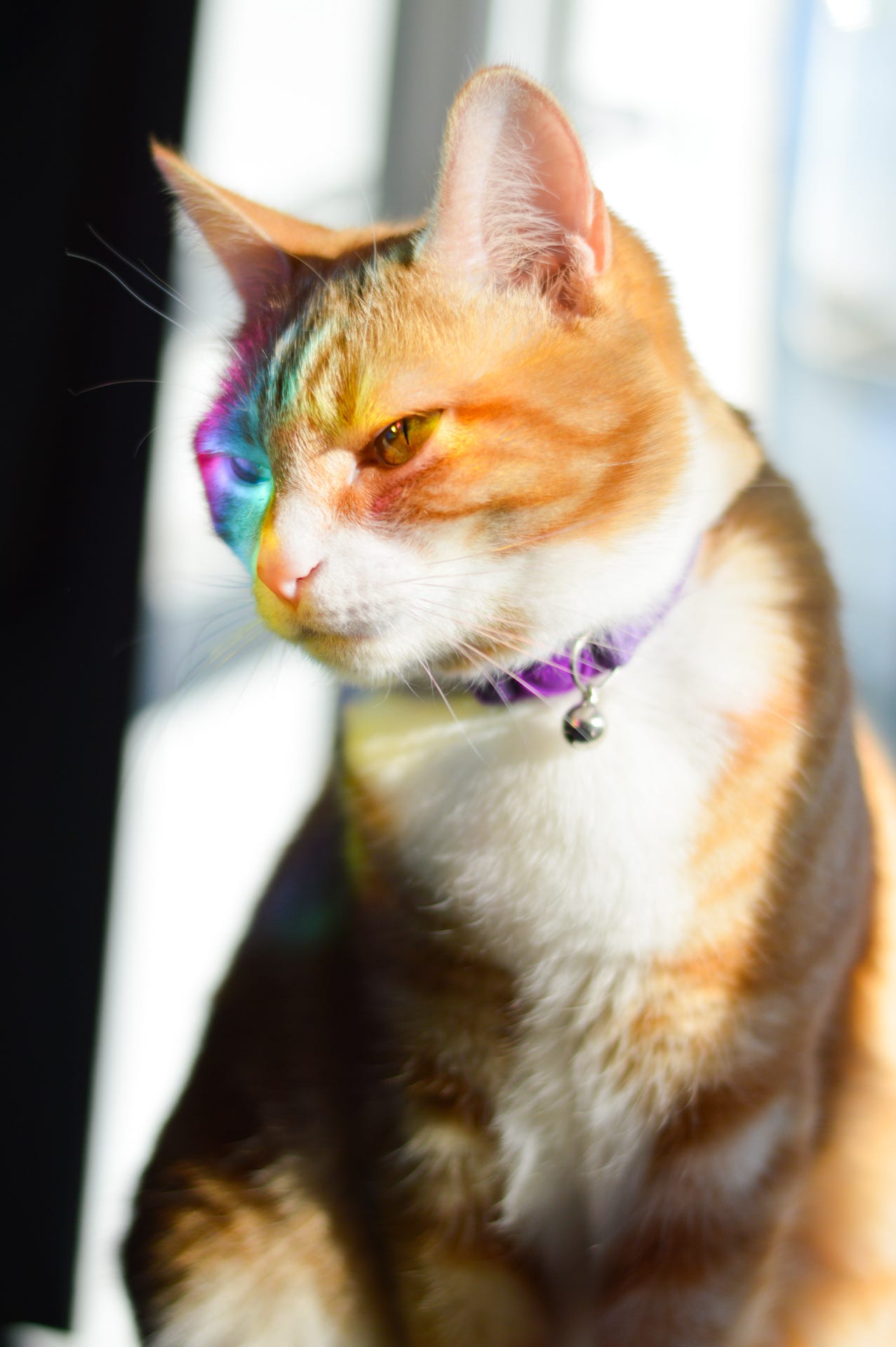
But before I could make the decision to get up or stay, my cat Poppy jumped up into bed with me. Curiously, I lifted the covers to see if she wanted to come underneath. She likes to do this unless our apartment is above 73 degrees, give or take.
Surprised, I watched her dimly lit orange body wriggle under the blanket, where she promptly curled up in the crook between my stomach and thighs. The purring started soon after, and her warmth shifted into me.
I felt uneasy as we laid there together. Without knowing the time, I could almost feel that my alarm was just about to go off. Unease scraped through my stomach.
But then, I remembered something. Other than the temperature of the room, Poppy was also very particular about what times of day she would crawl under the covers with me. If her automated feeder was about to go off—which it was scheduled to just minutes after my morning alarm—there was no way she would be cozying up in bed with me. She would be there waiting by the feeder, ready to descend on her breakfast as soon as the first kibble had clanged into the metal pan.
So…I had a choice.
I could leave the perfect comfort of snuggling with my cat to check the clock, thereby squashing any uncertainty that my alarm was about to go off.
Or, I could choose to trust Poppy.
Trusting my cat’s inner clock meant that I would have to give up my desire to know the time. It could have been hours or seconds away from when my alarm would go off, but I wouldn’t know. I would be flying blind with nothing but a purring cat to keep me grounded.
I settled into bed, feeling myself relax as I chose to rely on Poppy. I didn’t know how much longer I would have to rest, but at least I could trust that I had more time.
As I laid there, tired but not quite enough to fall back to sleep, I reflected on the idea of trust. I knew almost instantly that I was going to write about that moment with Poppy, because trust has been hard to come by recently.
OCD is often called the “doubting disorder,” and it means that my brain really, really craves certainty.
And it really, really hates uncertainty.
Your brain is probably like this too in some ways, especially if you struggle with any form of anxiety. We long to know, to predict, to control. We feel like we won’t be okay until we get some kind of firm grasp on the truth or situation that has us spinning.
What is it for you?
A job? A relationship? An illness? A financial crisis?
For my brain, it’s all about the certainty of knowing that I’m “good.” I’m terrified of doing the wrong thing in God’s eyes, certain that if I make any choice that dishonors him, I’ll leave him disappointed and distant from me. My obsessions cycle through themes of theological issues, everything from salvation to doctrine to what media is okay to consume.
So where does trust come in? And how does all of this connect to my cat?
Choosing to believe that Poppy knew the time better than I did not only took trust, but it also took sacrifice. I had to sacrifice the certainty I wanted—the knowledge of how much time I had left in bed—for the sake of faith. It was only after I traded away my impulse for assurance that I was able to settle into bed and experience peace.
I think this reflects what it could look like when we put our trust in God. In order to trust him, we have to first give something away. We have to be willing to walk into the uncertainty that is demanded of faith and sacrifice our need to be in control. It’s not that trust is completely blind, but it always means that we don’t get to see the full picture. There will always be some shred of uncertainty, some hint of mystery, some trace of unknowns. Trust demands that we let go of needing to know everything, to predict everything, to control everything.
Because of this, choosing to trust God can feel really scary. It’s terrifying to let go of the certainties that we try to protect ourselves with. But if we ever want to feel the peace that comes with trusting God, we have to lay them down.
I do want to be honest about something. Though I believe that trusting God leads to peace, I don’t think that we always experience peace as we’re actively choosing to trust him. Trust requires bravery, and as my counselor once said to me, you can’t be brave unless you’re also afraid.
For me, trusting God looks like depending on his word even when OCD doubts that I’m truly loved. It means choosing to put my trust in his promise of salvation even when it doesn’t feel like it’s true.
I still have a long, long way to go when it comes to trusting God. But through this journey of learning to live in the uncertainty that OCD brings, I think he’s slowly teaching me how to put my faith in him again.
It feels like walking a tightrope over a gaping chasm at first, but the more I make that choice of trust despite the doubts, the closer I feel to the green pastures waiting on the other side.
Beautiful message Rach. Thank you for trusting God, yourself, and your audience to put these thoughts and images out there. You are touching lives with your writing.